Tower Bridge London: History and Iconic Design
Tower Bridge London is one of the most recognizable sights in the world. Spanning the River Thames, this UK landmark is often mistaken for London Bridge, but it has its own dramatic story, striking design, and lasting place in British history. More than just a crossing, it is a symbol of Victorian engineering and a treasured part of the city skyline.
Why Tower Bridge Was Built
In the late 19th century, London was growing quickly, and the East End needed a new river crossing. The problem was simple but challenging: the River Thames was busy with large ships, so any bridge had to allow river traffic to pass freely.
The answer was Tower Bridge London, a combined bascule and suspension bridge designed to meet both needs. Construction began in 1886 and took eight years to complete. The bridge officially opened in 1894, created to improve access across the river without blocking the movement of ships heading to the docks.
Its location, close to the Tower of London, also gave the bridge its name. The result was a practical structure that also became one of the most famous examples of historic bridge architecture in the world.
A Masterpiece of Historic Bridge Architecture
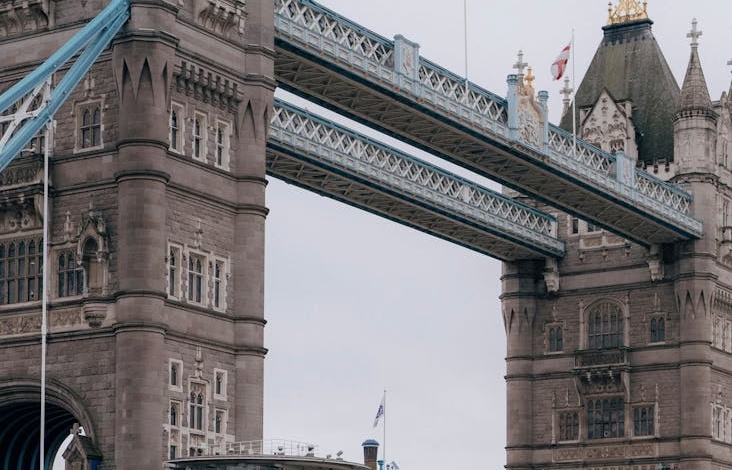
Tower Bridge is admired not only for what it does, but for how it looks. Its Gothic-style towers were designed to blend with the nearby Tower of London, giving the bridge a grand, almost medieval appearance. At the same time, the engineering behind it was highly modern for its day.
The bridge combines several key features:
– Two strong towers connected by high-level walkways
– Bascule arms that rise to let ships pass
– Suspension elements that support the roadway
– Stone cladding that hides the steel framework beneath
This mix of beauty and function makes Tower Bridge London a standout among bridges around the world. It is not just a crossing point; it is a carefully designed piece of engineering that reflects the ambition of Victorian Britain.
How the Bridge Works
One of the most fascinating things about Tower Bridge is the way it opens. The central roadway is split into two movable sections, known as bascules. When large vessels need to pass through, these sections are raised upward, creating an open channel through the river.
Originally, the bridge used steam power to operate its lifting mechanism. Today, the system runs on modern hydraulics, but the principle remains the same. Even after more than a century, the bridge still opens several times a day, preserving an important part of London’s river tradition.
For visitors, watching the bridge lift is one of the most memorable experiences in the city. It shows how the structure continues to serve the Thames while also acting as a living piece of history. For a wider look at Roman-era engineering in another iconic setting, see this journey through the ancient ruins of Ephesus.
Tower Bridge and the London Skyline
Few structures offer a better Thames river view than Tower Bridge. From the bridge itself, the river stretches into the heart of the city, with landmarks lining both banks. Looking east, you can see a more modern London; looking west, the historic and political center of the capital comes into view.
The bridge has become a favorite subject for photographers, artists, and travelers because it captures London’s unique mix of old and new. By day, it stands as a proud symbol of the city. By night, when illuminated, it becomes even more dramatic, reflected in the water below.
Its image is used worldwide to represent London, and for many people, it is the first place they imagine when they think of the city. For official visitor details and the bridge’s current opening times, the Tower Bridge official website is a helpful resource.
From Utility to Global Icon
When Tower Bridge London was first built, it was a working bridge designed for everyday transport. Over time, however, it became much more than infrastructure. As the city changed, the bridge’s importance shifted from purely practical use to cultural and historical significance.
Today, it is one of London’s most visited attractions. The high-level walkways now offer panoramic views and help visitors understand the bridge’s construction and place in the city’s development. The bridge also hosts exhibitions that explain its engineering, history, and maintenance.
Some of the reasons it remains so popular include:
– Its location near other major attractions
– Its iconic shape and appearance
– The chance to experience a classic UK landmark up close
– The stunning Thames river view from its walkways
A Lasting Symbol of London
Tower Bridge continues to stand as a reminder of London’s ability to adapt and grow without losing its heritage. It reflects the city’s industrial past, its engineering skill, and its sense of identity. Few landmarks combine usefulness, beauty, and history so successfully.
More than 130 years after it opened, Tower Bridge London remains one of the finest examples of historic bridge architecture and one of the most admired structures in the United Kingdom. Whether seen from the river, crossed on foot, or admired from afar, it remains a powerful symbol of London’s past and present.