China: Ancient Civilization and Modern Growth
China is a country of remarkable contrasts, where ancient dynasties, philosophical traditions, and world-famous landmarks exist alongside futuristic skylines, high-speed rail, and global economic influence. For travelers, history lovers, and curious readers alike, it offers an experience that is both deeply rooted in the past and constantly moving toward the future. From imperial capitals and sacred mountains to bustling financial centers and rich culinary traditions, this vast nation continues to fascinate people from around the world.
One of the most striking things about China is its long and continuous history. As one of the world’s oldest civilizations, it has shaped human development through inventions, political systems, art, literature, and trade. Paper, gunpowder, printing, and the compass all emerged from Chinese innovation. Dynasties such as the Han, Tang, Song, Ming, and Qing left behind architectural masterpieces, administrative systems, and cultural achievements that still influence life today.
At the same time, modern China has become a symbol of rapid transformation. In just a few decades, it has experienced extraordinary urban development, technological progress, and industrial growth. Cities that were once primarily regional centers are now global hubs for finance, manufacturing, fashion, and innovation. This combination of historical depth and modern energy makes the country especially compelling for travel and cultural exploration.
Table of Contents
China’s ancient civilization and lasting heritage
To understand China today, it helps to appreciate the strength of its ancient foundations. Traditional Chinese thought was shaped by philosophies such as Confucianism, Taoism, and Buddhism. Confucianism emphasized family loyalty, education, social harmony, and respect for elders—values that continue to influence daily life. Taoism contributed ideas about balance, nature, and simplicity, while Buddhism added spiritual traditions that enriched art, architecture, and ritual.
Chinese culture is equally known for its artistic and intellectual richness. Calligraphy, poetry, painting, opera, ceramics, and silk production have all played important roles across centuries. Festivals such as Lunar New Year and Mid-Autumn Festival remain essential expressions of community and family life. Food also carries deep cultural meaning, with regional cuisines reflecting geography, climate, and local identity.
Language is another key part of this heritage. Mandarin is the official language, but many regional dialects and linguistic traditions exist across the country. Written Chinese, with its character-based system, represents one of the oldest continuously used writing forms in the world. This connection between language, identity, and history is central to Chinese culture.
For readers who want to explore more background on historical landmarks and scenic heritage, this guide to the Great Wall of China landscape offers a useful companion perspective.
China’s heritage is also visible in its carefully preserved historic towns and UNESCO-listed sites. Ancient cities such as Pingyao and Lijiang showcase traditional street layouts, courtyard homes, and defensive walls that reveal how communities once lived and traded. Temple complexes, ancestral halls, and old caravan routes further illustrate the country’s deep connection to religion, commerce, and family lineage. These places are not only tourist attractions; they are living reminders of how long Chinese civilization has endured and adapted.
The influence of China’s past extends beyond monuments and into social values. Respect for learning, reverence for ancestors, and the importance of collective harmony still shape many aspects of life. Even in modern cities, these traditions can be seen in family gatherings, school expectations, and public celebrations. That continuity is one reason China feels so layered: it is both ancient and contemporary, sometimes in the same street or neighborhood.
The Great Wall of China and other iconic landmarks
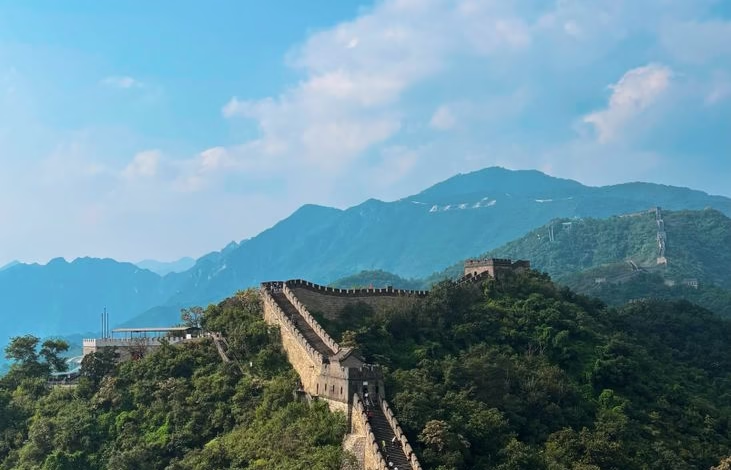
No discussion of China is complete without mentioning the Great Wall of China. Stretching across mountains, deserts, and plains, this extraordinary structure stands as one of humanity’s most impressive engineering achievements. Built and rebuilt over centuries to protect imperial territories, the wall is not a single continuous line but a vast network of fortifications. Today, it remains a powerful symbol of endurance, ambition, and national identity.
Popular sections near Beijing, such as Badaling and Mutianyu, attract visitors who want breathtaking views and relatively accessible routes. Those seeking a less crowded experience may prefer more rugged and partially restored sections, where the wall feels even more closely connected to the landscape and history that shaped it.
Beyond the Great Wall of China, the country is home to an astonishing variety of historic sites. The Forbidden City in Beijing reveals the grandeur of imperial rule, while the Terracotta Army in Xi’an offers a glimpse into the ambitions of China’s first emperor. The classical gardens of Suzhou, the ancient water towns of the Yangtze Delta, and the Buddhist grottoes of Dunhuang all demonstrate the range and beauty of Chinese artistic expression.
Landmarks are important in China not only because they are visually impressive, but also because they connect visitors to different eras of the nation’s development. The Summer Palace shows the elegance of imperial leisure, while the Temple of Heaven reflects ritual and cosmology. In the west, the caves of Mogao preserve paintings and sculptures that document centuries of religious exchange along the Silk Road. In the south, karst mountains and river landscapes provide a natural contrast to the grand human-made monuments found in the north and central plains.
For a broader travel perspective on remarkable scenery, you can also compare it with other destinations in places that look unreal, where dramatic landscapes and striking views are highlighted around the world.
Many travelers discover that Chinese landmarks are most rewarding when viewed as part of a larger story. Military defense, imperial power, spiritual practice, and artistic refinement all appear in different forms across the country. This variety means that a journey through China can feel like moving through several civilizations at once, each one contributing a distinct chapter to the national identity.
Beijing: imperial history and national identity
Beijing stands at the heart of China’s political and historical story. As the nation’s capital, it combines monumental architecture, government institutions, cultural landmarks, and a strong sense of continuity with the imperial past. For many visitors, Beijing is the ideal starting point for understanding the country’s identity.
The city’s most famous attraction is the Forbidden City, a vast palace complex that once housed emperors of the Ming and Qing dynasties. Walking through its courtyards and halls gives a vivid sense of ceremony, power, and design. Nearby, Tiananmen Square represents a different chapter of national history and remains one of the most recognized public spaces in the world.
Beijing is also a city of temples, hutongs, and modern development. The Temple of Heaven, where emperors once performed sacred rituals, is an architectural masterpiece and a peaceful retreat within the urban landscape. Traditional hutong neighborhoods provide insight into older ways of life, even as many areas have been reshaped by expansion and modernization. At the same time, new business districts, museums, and transit systems reflect the city’s role in contemporary China.
Food is another reason Beijing leaves a lasting impression. Peking duck is the city’s most famous dish, but local cuisine includes hearty noodles, dumplings, savory pancakes, and street snacks that reveal both tradition and daily urban life.
Beijing also offers a deeper understanding of how national identity is presented to citizens and visitors alike. Grand avenues, monumental squares, and carefully preserved heritage sites all communicate a sense of continuity and resilience. The city’s museums and cultural institutions help tell the national story in a way that links ancient dynasties to modern governance, giving travelers a fuller picture of how China sees itself.
At street level, Beijing is equally revealing. Morning exercises in parks, vendors selling seasonal snacks, and residents cycling through narrow lanes show that the capital is not only a political center but also a lived-in city with daily rhythms. This balance between ceremonial importance and ordinary life gives Beijing much of its appeal.
Shanghai and the rise of modern China
If Beijing tells the story of imperial power and state identity, Shanghai reflects China’s global ambition and economic momentum. Located on the eastern coast, Shanghai has grown into one of the world’s most dynamic cities. It is known for its skyline, international character, and blend of historical districts with cutting-edge architecture.
The Bund is one of Shanghai’s most iconic waterfront areas, where colonial-era buildings face the futuristic towers of Pudong across the Huangpu River. This visual contrast captures the city’s essence: a place where the past and future stand in direct conversation. Landmarks such as the Oriental Pearl Tower and Shanghai Tower symbolize the scale of modern Chinese development.
Yet Shanghai is more than business and skyscrapers. Neighborhoods filled with shikumen houses, art spaces, boutique shops, and tea houses reveal a more intimate side of urban life. Museums, galleries, and performance venues showcase the city’s creative energy, while its restaurants highlight both classic Chinese cuisine and global influences. For travelers, Shanghai offers a vivid look at how tradition and modernity can coexist in a rapidly changing environment.
The city’s growth also reflects broader economic changes across the country. Manufacturing, finance, logistics, and technology have all helped transform urban China into a major force in the global economy. New transit systems, airports, business districts, and residential neighborhoods reveal how quickly infrastructure has evolved. Shanghai is often the most visible example of that shift, but it represents a transformation taking place in many cities across the nation.
Still, Shanghai retains reminders of its layered history. Former concessions, preserved lane houses, and old commercial streets provide texture beneath the gleaming skyline. This mix of influences makes the city especially interesting for travelers who want to see how a modern metropolis can still preserve traces of its earlier identity.
Chinese culture in everyday life
Chinese culture is often discussed through grand historical themes, but it is just as meaningful in everyday routines and relationships. Family remains a central value, and meals are often communal events that emphasize sharing. Tea culture, respect for elders, education, and seasonal festivals continue to shape social life across generations.
Regional diversity is especially important. The food, architecture, customs, and local traditions of Sichuan differ greatly from those of Guangdong, Yunnan, or Inner Mongolia. This variety means that travel within China can feel like visiting several distinct worlds within one nation. Spicy dishes in Chengdu, delicate dim sum in the south, and wheat-based noodles in the north all reflect the country’s immense geographic and cultural range.
Traditional arts also remain visible in contemporary life. Visitors may encounter tai chi in public parks, red lanterns during festivals, calligraphy demonstrations in markets, and ancient musical instruments in cultural performances. Even in fast-moving cities, these practices preserve a sense of continuity and identity.
Modern daily life in China also reveals how rapidly habits can change while traditions endure. Mobile payments, app-based delivery services, and digital communication are now common in urban centers, yet many families still organize life around shared meals, holiday gatherings, and respect for older generations. This combination of technology and tradition is one of the country’s defining features.
Festivals are particularly important because they bring these values into public view. During Lunar New Year, families travel long distances to reunite, decorate homes, and share symbolic foods. Mid-Autumn Festival centers on mooncakes, lanterns, and time with loved ones. These celebrations help maintain cultural continuity while giving each region its own local flavor.
Arts and crafts continue to matter as well. Handmade paper cuts, embroidery, porcelain, and woodblock prints survive alongside modern design and mass production. In many cities and towns, cultural centers, markets, and schools keep these traditions alive, allowing both residents and visitors to experience China as a living culture rather than only a historical one.
Travel tips for exploring China
Travel in China can be rewarding, especially with some planning. Because the country is so large, it helps to focus on a few regions rather than trying to see everything in one trip. Beijing, Shanghai, Xi’an, Guilin, Chengdu, and Hangzhou are among the most popular destinations, each offering a different perspective on history, landscape, and culture.
High-speed rail has made travel between major cities efficient and convenient. It is often one of the best ways to experience the country’s scale while staying comfortable. Domestic flights are also widely available for longer distances. In major urban centers, public transportation is usually modern, affordable, and easy to use.
When planning travel, visitors should consider the seasons. Spring and autumn are often the most pleasant times to visit many regions, while summers can be hot and winters quite cold in the north. It is also wise to prepare for language differences, digital payment systems, and local customs before arrival.
Official travel guidance can help visitors plan more smoothly, especially when checking entry rules and regional updates. The Travel China Guide site is a practical reference for routes, attractions, and transport information.
A respectful approach enhances the experience. Learning a few basic Mandarin phrases, observing etiquette at temples and historic sites, and staying open to unfamiliar foods or customs can make interactions smoother and more meaningful.
Travelers who want to make the most of a trip should also think about pacing. China rewards slower exploration, whether that means spending extra time in one city’s museums, taking a day to walk through old neighborhoods, or allowing space for a long train ride between destinations. Because distances are great and attractions are often concentrated by region, a well-planned itinerary usually leads to a richer experience than a rushed one.
It is also useful to prepare for practical details before departure. Internet access, mobile apps, cashless payment preferences, and local transport systems may work differently from what many international visitors expect. Having offline maps, translation tools, and essential travel documents on hand can make day-to-day movement much easier. These small preparations often make the difference between a stressful trip and a smooth one.
For travelers building a wider Asia itinerary, China can pair well with other destinations that offer strong historical and cultural depth. If you are planning around climate and regional conditions, best time to travel by country and continent is a helpful planning reference before choosing travel dates.
A country of heritage and progress
China continues to captivate the world because it offers far more than a single image or story. It is a civilization shaped by thousands of years of philosophy, art, invention, and statecraft, yet it is also a modern powerhouse defined by innovation, urban growth, and global influence. Whether you are drawn by the Great Wall of China, the imperial grandeur of Beijing, the futuristic appeal of Shanghai, or the richness of Chinese culture, the journey reveals a nation of extraordinary depth.
For anyone interested in history, travel, and the meeting of old and new, few destinations are as compelling or as unforgettable. China’s story is still unfolding, and that is part of what makes it so fascinating to explore.
What makes the country especially memorable is the way its contrasts feel connected rather than contradictory. Ancient ideas still shape family life, modern cities still preserve traces of older neighborhoods, and powerful national symbols continue to evolve alongside new technology and industry. This living blend of heritage and progress is what gives China its lasting appeal.
In that sense, a journey through China is not only about visiting famous landmarks. It is about seeing how one of the world’s oldest civilizations continues to adapt, innovate, and define itself in the present day. That ongoing transformation is exactly what makes China such a compelling place to learn about, reflect on, and explore.